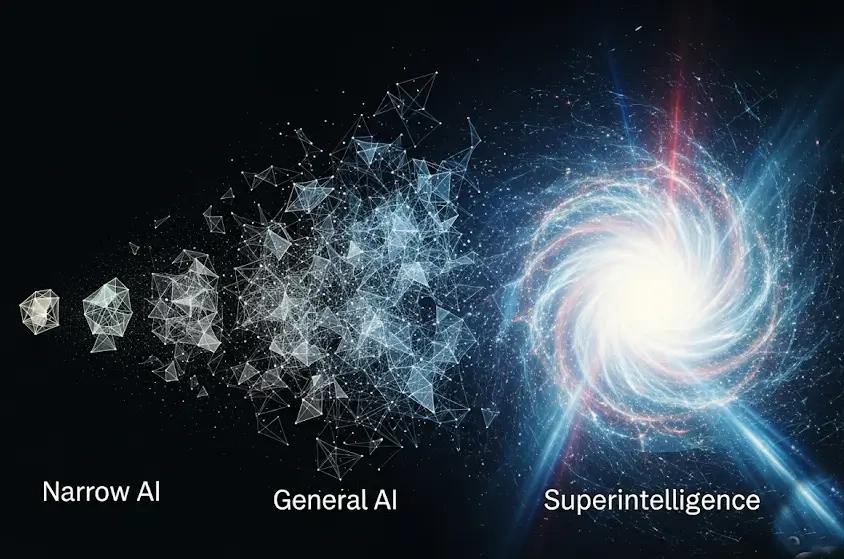
The field of artificial intelligence spans a vast spectrum of capabilities and potential. As businesses and technologists navigate this rapidly evolving landscape, it’s crucial to understand the distinct categories of AI: Artificial Narrow Intelligence (ANI), Artificial General Intelligence (AGI), and Artificial Super Intelligence (ASI). Let’s explore what each means and their implications for the future.
Artificial Narrow Intelligence (ANI)
Also known as “weak AI,” ANI represents the AI systems we interact with today. These systems excel at specific, well-defined tasks but lack the versatility of human cognition. Think of ANI as a highly specialized expert that can outperform humans in its domain but cannot transfer that expertise to other areas. Examples of ANI include:
- Healthcare: AI systems like IBM Watson for Oncology that analyze medical images to detect specific types of cancer with remarkable accuracy
- Gaming: DeepMind’s AlphaGo that defeated world champion Lee Sedol at Go, and OpenAI’s Dota 2 AI that beat professional players
- Industrial: Predictive maintenance systems that analyze sensor data to forecast equipment failures in manufacturing plants
- Finance: High-frequency trading algorithms that make split-second decisions based on market data
- Transportation: Tesla’s Autopilot system that handles specific driving tasks like lane-keeping and adaptive cruise control
- Customer Service: Chatbots like those used by banks and retailers that handle specific customer inquiries within defined parameters
- Content Creation: AI tools like DALL-E that generate images from text descriptions, but only within their trained capabilities
What makes ANI powerful is its ability to process vast amounts of data and identify patterns far more efficiently than humans. However, these systems don’t truly understand the context of their work – they operate within the boundaries of their programming and training data.
Artificial General Intelligence (AGI)
AGI represents the next frontier in AI development – systems that can match or exceed human-level cognition across any intellectual task. Unlike ANI, AGI would possess:
- True understanding and reasoning capabilities
- The ability to transfer knowledge between domains
- Creative problem-solving skills
- Self-awareness and consciousness (though this remains debated)
While we’ve made significant strides in AI development, achieving AGI remains a substantial challenge. It requires not just processing power, but fundamentally new approaches to machine learning, knowledge representation, and cognitive architecture. While AGI doesn’t exist yet, here are theoretical examples of what it might be capable of:
- Multi-Domain Expertise: An AGI system could seamlessly switch between performing surgery, designing buildings, and composing music - all with human-level competence or - better
- Adaptive Learning: The same system could learn to play a new sport or musical instrument just by watching, similar to how humans learn
- Creative Problem-Solving: It could devise novel solutions to climate change by combining knowledge from physics, biology, economics, and social sciences
- Natural Interaction: The system would engage in natural conversations about any topic, understanding context, emotions, and subtle cultural references
- Self-Improvement: It could identify its own limitations and develop new ways to enhance its capabilities
- Teaching and Mentoring: The system could adapt its teaching style to each student’s needs, drawing from deep understanding of both the subject matter and human psychology
The development of AGI would mark a pivotal moment in human history, revolutionizing every field.
Artificial Super Intelligence (ASI)
ASI represents a hypothetical future where AI systems surpass human intelligence not just in specific areas, but in virtually every aspect of cognition and creativity. This level of intelligence would be difficult for human minds to comprehend, much like how ants cannot grasp human technology and society. While ASI remains purely theoretical, here are speculative examples of what it might be capable of:
- Scientific Breakthroughs: Discovering unified theories of physics that reconcile quantum mechanics with general relativity in ways humans never imagined
- Medical Advancement: Creating cures for all known diseases by understanding biological systems at a level far beyond human comprehension
- Technological Innovation: Developing new forms of energy generation, computing, or space travel that seem like magic by today’s standards
- Environmental Solutions: Solving global challenges like climate change through methods that combine multiple advanced technologies in ways humans couldn’t conceive
- Cognitive Enhancement: Creating interfaces or technologies that could safely enhance human cognitive capabilities
- Universal Understanding: Comprehending and modeling complex systems like global weather patterns, economic markets, and human behavior with perfect accuracy
- Space Exploration: Designing and implementing solutions for interstellar travel and civilization expansion beyond Earth
These examples are highly speculative and meant to illustrate the theoretical capabilities of a super intelligent system that would far exceed human cognitive abilities in every domain. The implications of ASI development are profound and raise important questions about:
- Human-AI coexistence
- The future of work and human purpose
- Safety and control mechanisms
- Ethical considerations in AI development
Current State and Future Outlook
As of early 2025, we remain firmly in the era of ANI, with systems becoming increasingly sophisticated within their specialized domains. Interestingly Sam Altman, in his recent blog post Reflections, is confident that we are closer to AGI. While AGI remains a long-term goal, organizations like IntWorks continue to push the boundaries of what’s possible with current AI technology. The path from ANI to AGI, and potentially to ASI, requires not just technological advancement but careful consideration of:
- Ethical frameworks for AI development
- Safety protocols and control mechanisms
- Societal implications and adaptation strategies
- International cooperation and governance
Conclusion
Understanding the distinctions between ANI, AGI, and ASI is crucial for businesses and technologists planning for the future. While AGI and ASI remain theoretical concepts, current ANI systems continue to transform industries and create new possibilities. At Intworks, we remain committed to responsibly advancing AI technology while maintaining a clear perspective on both its current capabilities and future potential. The journey from narrow to general and potentially super intelligence represents one of humanity’s greatest technological challenges. As we progress along this path, maintaining a balance between innovation and responsibility will be key to ensuring that AI development benefits all of humanity.